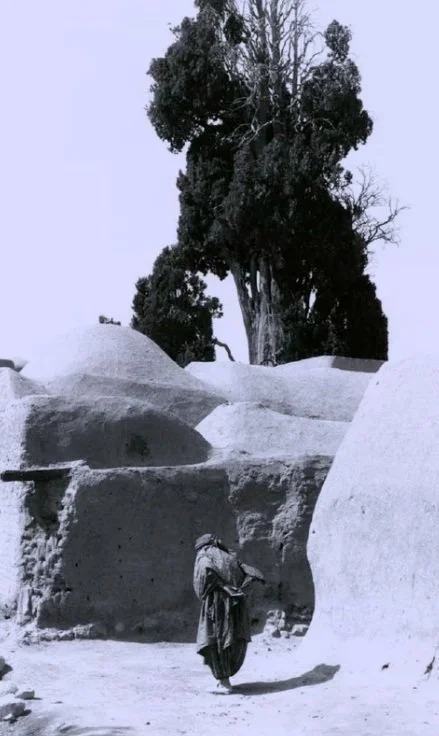
The Silver Cypress سرو سیمین imagines a world both dystopian and mythic. Here, not only has water disappeared from the land, but tears, the water within humans, have also been depleted. In this story, the loss of tears is not simply physical; it signals the loss of memory, empathy, and the capacity to be moved by one another. Tears, in The Silver Cypress, carry stories. They are what bind people to one another, what allow them to listen with an open heart, to be changed by another’s experience, and to participate in the life of a community.
Our protagonist is a young woman orphaned by human conflict and raised in lands devoid of water where empathy is scarce. Leaving the small compound where she was raised, she sets out in search of her lost adopted brother, and, ultimately, to save a sacred tree. In the process, she will reclaim both her people's cultural memory and her own identity.
This is not only a physical quest, but a journey towards recovering the human capacity to feel, to express, and to empathize. Drawing from Persian mythology, Farsi poetry, and epic literature, the opera uses a mythic frame to address an urgent contemporary condition: how quickly we lose the willingness to truly hear one another, and how necessary it is to reclaim that openness. In this opera, the restoration of storytelling becomes the restoration of life itself. Once stories can be shared again, empathy can return; and through that return, the waters of the land will be restored. The voice itself is the vessel through which memory, compassion, and renewal become possible.
THE SILVER CYPRESS
music by Niloufar Nourbakhsh
libretto by Stephanie Fleischmann
directed by Mary Birnbaum
inspired by a story by Anahita Ghazvinizadeh
dramaturg: Annie Wang
commissioned by Beth Morrison Projects
developed c/o Banff Center for the Arts
premiere: LA Opera, 2028 / Prototype, 2029